Laurie Buckhout carried all six coastal counties that North Carolina Republicans moved into the House district they wanted her to win. She led Democratic Rep. Don Davis by 18,032 votes across those counties. Davis still led districtwide by 10,305 in the state’s preliminary returns available November 6. Next door, the four counties moved into Republican Rep. Greg Murphy’s district backed his Democratic challenger, Raymond Smith, by enough to cut Murphy’s overall lead to just 233 votes.
That’s the risk of a dummymander, a gerrymander that backfires on the party that drew it. North Carolina’s county swap brought Buckhout a bloc of friendly voters, as Republicans intended. It also made a seat they held less secure on past voting patterns. In the first House count on the new lines, Republicans were still behind in the district they wanted and barely ahead in the one they already held.
A pickup attempt put a neighboring seat in play
The North Carolina General Assembly’s maps and election reports show how the swap worked. Lawmakers moved Beaufort, Carteret, Craven, Dare, Hyde and Pamlico counties from Murphy’s 3rd District into Davis’s 1st. They moved Greene, Lenoir, Wayne and Wilson the other way. They also sent part of Onslow County into the 1st. For people in those places, the address on their voter registration stayed the same and the names on their House ballot changed.
Carteret gave Buckhout her biggest margin among the six counties she picked up. She also led in Craven, the next largest source of votes for her in that group. Davis made up the difference elsewhere. The inland counties showed how close the trade came to hurting Murphy at the polls. He led Smith by 2,604 votes across the rest of the 3rd District. The four counties he gained cut that lead by 2,371, with Wilson County doing the most to close the gap.
Davis and Buckhout had already faced each other two years earlier, when Davis won under the old lines. The map gave Buckhout a different electorate for the rematch, and she still drew a slightly smaller share of the House vote in the preliminary count than she did in 2024. Murphy had no Democratic opponent in 2024. This time, Smith came out ahead across the counties the map added to the 3rd.
The same two groups backed the same parties in the Senate race. Republican Michael Whatley led across the six coastal counties combined, and Democrat Roy Cooper led across the four inland counties combined. That pattern matched the House results. The legislature’s comparison of the two maps shows why the exchange was a gamble. When it put the same 2020 presidential votes on both maps, Trump’s margin in Murphy’s district fell by roughly half.
Fediwire matched 236,638 census block IDs in the state legislature’s 2023 and 2025 assignment files.
District 3 → 1: 10,818 blocks. District 1 → 3: 8,008 blocks. Twelve districts had no block changes.
Georgia offers a case where the losses showed up in the election returns. In their study of Southern House maps, political scientists Bernard Grofman and Thomas Brunell describe how Georgia Democrats tried to protect more seats than their support could sustain in the 1990s. The map also created majority-Black districts under federal voting rights review. When Republicans made gains in 1994, Democratic incumbents including Buddy Darden and Don Johnson lost.
Texas’s 23rd District shows a smaller loss of Republican ground. The Texas Legislative Council’s map reports show Donald Trump’s 2024 margin narrowing slightly when the same votes were put on the new lines. The separate House result was much clearer. In Texas’s preliminary returns, Democrat Katy Padilla Stout led Republican Brandon Herrera by more than 22,000 votes.
Races that defied the maps
Six Republican-held North Carolina districts had Democrats ahead even though lawmakers left their lines alone. They included the 9th, where Richard Ojeda led Rep. Richard Hudson, and the 5th, where Chuck Hubbard led Rep. Virginia Foxx. The other four were the 6th, 11th, 13th and 14th. The 2025 law changed only the two districts on the coast.
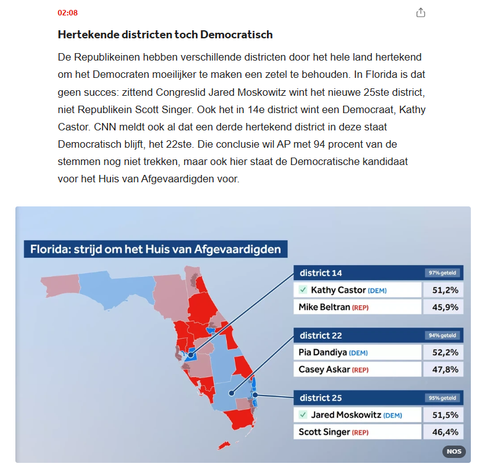
In Texas, Democrats Vicente Gonzalez and Johnny Garcia led in the 34th and 35th, even though the redraw gave Trump wider margins in the state’s comparison of 2024 votes. Bobby Pulido led Republican Rep. Monica De La Cruz in the 15th, where Trump’s share on the two maps was the same to one decimal place. Florida also had Democrats ahead in four redrawn districts, including Reps. Kathy Castor and Jared Moskowitz. In Florida’s 9th, Darren Soto trailed in five of the seven county portions that make up the district. His margins in the Osceola and Orange portions were big enough to put him ahead overall. His lead came from the two counties where he ran strongest in the district, even though his opponent led in more places.
Some proposals stopped before Election Day. The discussion that started this reporting was a Bluesky post by election analyst Stephen Wolf, found through Wildroot. Wolf mapped Indiana’s secretary of state votes onto proposed House lines that the state Senate had rejected. Fediwire compared both races in the same Hamilton County precincts and found a wider lead for the Democrat running statewide than for the Democrat running for the House.
Fediwire matched 234 precincts in Hamilton County’s unofficial election-night report. Different vote totals and candidates limit the comparison.
Secretary of state: Bayh +14.7 points. U.S. House: Ford +10.8 points.
Missouri used its previous map for the November House election after a referendum petition and a court ruling kept the new lines from taking effect. Proposals in Virginia, South Carolina and Maryland also stopped short of the general election. The state tracker shows which plans took effect, including court-led changes in Alabama and Utah and new lines for Louisiana’s House primary. It also identifies the county returns cited for Ohio and Tennessee.
- Different lines
- Different lines, November primary
- Plan did not govern the general election
The highlights identify map status. Louisiana held its House primary in November. The five rust-hatched states are examples of plans that did not govern the general election.
Open the state-by-state evidence
- AlabamaDifferent lines in use
- A Supreme Court stay cleared the way for different lines. Democratic incumbent Shomari Figures led in the 2nd District in the unofficial state count.Supreme Court order · State returns
- CaliforniaDifferent lines in use
- Voters approved Proposition 50 in 2025. Democrats led in 48 of 52 districts, compared with 43 winners by district number in 2024. The 2026 results were preliminary.Certified ballot result · Secretary of State House returns · Certified 2024 summary
- FloridaDifferent lines in use
- Legislators adopted a new map. Unofficial state figures put Democrats ahead in Districts 9, 14, 22 and 25.Senate bill summary · State House results · District 25 county breakdown · District 9 county breakdown · District 22 county breakdown
- LouisianaDifferent lines, November primary
- Lawmakers adopted a replacement after the Supreme Court’s Callais ruling. The November House contest was an open primary. A December general election follows where required.Legislative map records · Secretary of State calendar
- North CarolinaDifferent lines in use
- Only Districts 1 and 3 changed in the 2025 plan. The Democrat led in District 1, where lawmakers set a Republican vote-share objective. The Republican led District 3 by 233 votes in the checked file.Map files · Map criteria · State precinct results
- OhioDifferent lines in use
- The state redistricting commission adopted the map in October 2025. Marcy Kaptur led in Lucas County’s part of District 9. The county report alone does not establish the district outcome.Secretary of State maps · Lucas County unofficial returns
- TennesseeDifferent lines in use
- New lines were adopted in May. Democrat Justin Pearson led in Shelby County’s part of District 9. This review did not verify a districtwide outcome.Legislative bill and votes · Shelby County unofficial returns
- TexasDifferent lines in use
- Official map tables give different shifts by district. Democrats led in Districts 15, 23, 34 and 35. A Republican led in District 32.Enacted map and analysis · State election-night returns
- UtahDifferent lines in use
- A judge selected the remedial map. In the unofficial count, Democrat Ben McAdams led Republican Riley Owen in District 1.Judicial order, archived copy · State House results
- IndianaPlan did not govern the general election
- The state Senate defeated HB 1032. The proposed map never governed a House race.Engrossed bill, archived copy · Legislative vote record
- MissouriPlan did not govern the general election
- The state Supreme Court kept the 2022 map in force for the November general election and ordered the 2025 plan placed before voters as Proposition A.Missouri Supreme Court opinion · Official ballot question
- VirginiaPlan did not govern the general election
- The state Supreme Court voided the April redistricting referendum. State election administrators kept the previous boundaries for 2026.Department of Elections notice · Court opinion
- MarylandPlan did not govern the general election
- House Bill 488, which would have created 2026 districts, failed. A separate constitutional measure did not put that map into use for the November election.Legislative session report · Maryland district maps
- South CarolinaPlan did not govern the general election
- The House passed a map proposal. The Senate adjourned without giving it a third reading.Legislative history · Governor’s statement
Where the returns went the mapmakers’ way
In Texas’s 32nd District, the old boundaries gave Kamala Harris the lead on 2024 presidential votes. Put those same votes on the new lines and Trump comes out ahead. Republican Jace Yarbrough led Democrat Dan Barrios in the preliminary House count. In that district, the party that gained ground on paper also led the race.
- Old lines
- New lines
The Texas Legislative Council applied the 2024 presidential results to both plans. The party label gives the leader in a different contest: the actual, unofficial 2026 House race.
| District | Old lines | New lines | 2026 leader |
|---|---|---|---|
| TX-15 | 17.9 | 17.9 | Democrat |
| TX-23 | 15.5 | 14.8 | Democrat |
| TX-32 | -23.6 | 17.7 | Republican |
| TX-34 | 4.5 | 10.1 | Democrat |
| TX-35 | -33.5 | 10.4 | Democrat |
California voters approved temporary House maps through Proposition 50 in response to Texas’s redraw. California’s preliminary results put Democrats ahead in 48 of the state’s 52 House races. Five of those districts had numbers that elected Republicans in 2024, including the redrawn 1st, where Democrat Mike McGuire led Republican James Gallagher. The early count pointed toward a larger Democratic delegation, the outcome supporters had sought.
In North Carolina, county canvasses were scheduled for November 13 and the state canvass for November 24. The two races give Republicans different stakes in that count. In the district they tried to pick up, Davis’s lead was more than 10,000 votes. In the district they started with, fewer than 250 votes separated Murphy and Smith.